
Bad Religion

What you’ll read about in this post:
Americans will largely claim that Christianity is the dominant religion in this country. I don’t believe this is an accurate portrayal of our society. The religion we tend to fashion best is a civic religion which demands unquestioning allegiance.
What are the hallmarks of any religion and how does ‘Americanism’ fit into this mold?
President Trump is attempting to cement his place in the pantheon of Americanism, portraying himself as a messiah-like figure.
“The unspoken mantra of the post-war evangelicalism was simple: Jesus can save your soul; but John Wayne will save your ass.”
— Alan Bean
Americans worship America
Despite an overall decline in the number of Christians, a strong majority of Americans still self-identify as Christians. More than 60% of us still proclaim the faith, which could use improvement, but it’s not nothing, either. Except, the American church, writ large, has a problem. I think the polling data overestimates the number of Christians. We might like Jesus, and even follow him most of the time, but the nation worships another god.
A secular religion haunts the United States, and it has done so for our entire history. We live under a perverse American nationalism, whose influence has waxed and waned over the years. This ‘Americanism’ glorifies ourselves and our own success above everything else.
It would be tempting to associate this only with the political right, but that’s just its current iteration. This religion, like a virus, adapts and alters its DNA from one generation to the next. Americanism fuses its preferred facets of Christianity with our own cultural ways of living to create something new, something altogether different.
Our religion is Americanism, a well-intentioned, but misguided belief system that is political, but contains just enough Christian words and phrases to make it palatable. We love freedom, fireworks, guns, apple pie, capitalism, and independence. It’s not a Christian nation, and it never was.
The Hallmarks of a Religion
How can people worship a country? Many Americans would claim they don’t worship anything or anyone. That’s a misunderstanding of what it means to worship. What is the most important aspect of your life? To what or whom do you devote your time and energy? That’s the focus of your worship.
Despite the differences in world religions, certain traits are common among these faith beliefs. Here are a few of these and how Americanism incorporates them:
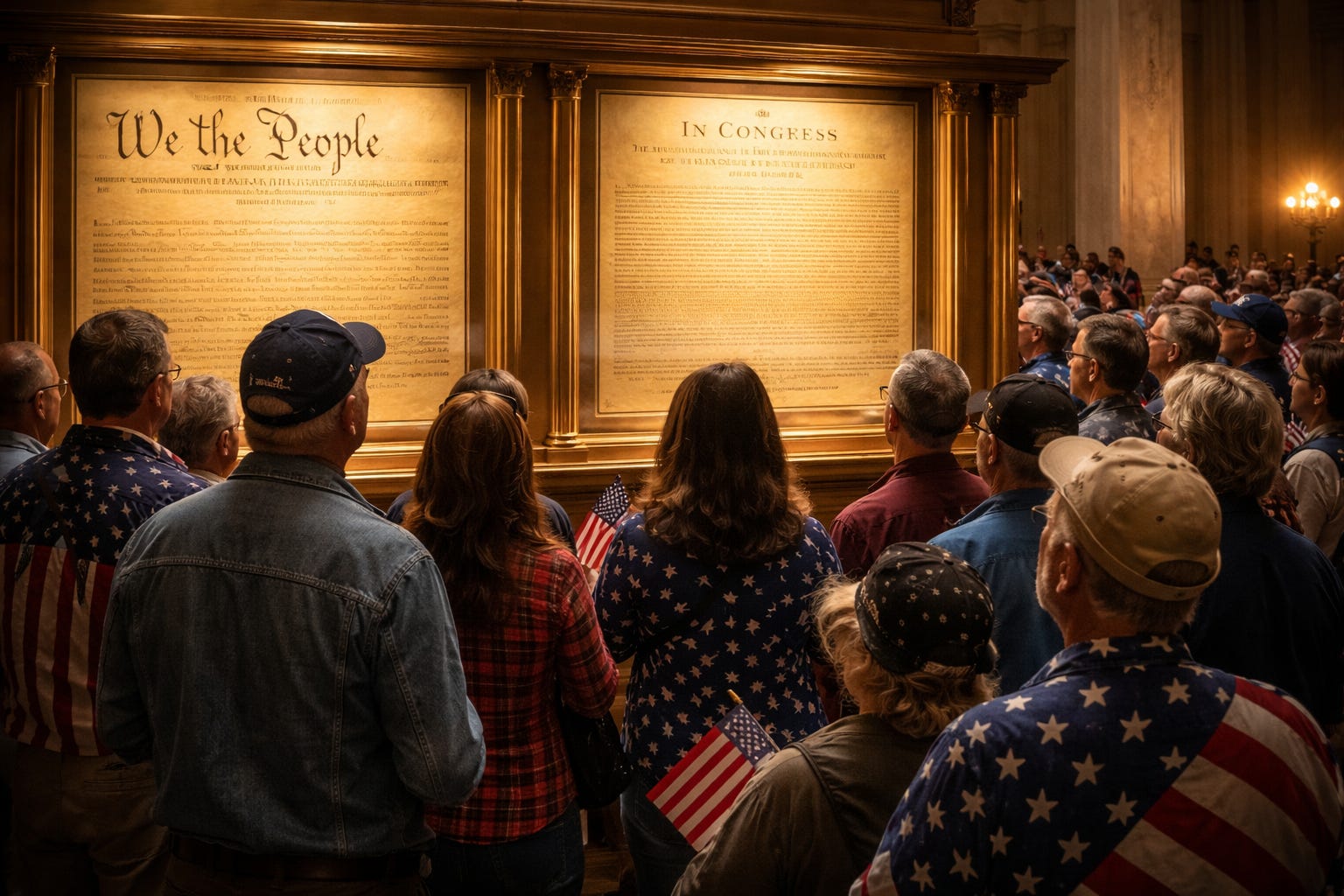
Sacred texts — Americanism doesn’t have a Bible, but it has important texts. The Declaration of Independence, the Constitution, and the Federalist Papers are the core scripture for the belief system. The values and texts are so revered by Americans, to the point where contradicting them is seen as a form of blasphemy.
Other famous texts such as the Gettysburg Address or Martin Luther King’s Letter from Birmingham Jail reinforce the ideas laid down at the inception of the United States. Americans also have latched on to mottos, patriotic songs, and other uniquely American texts.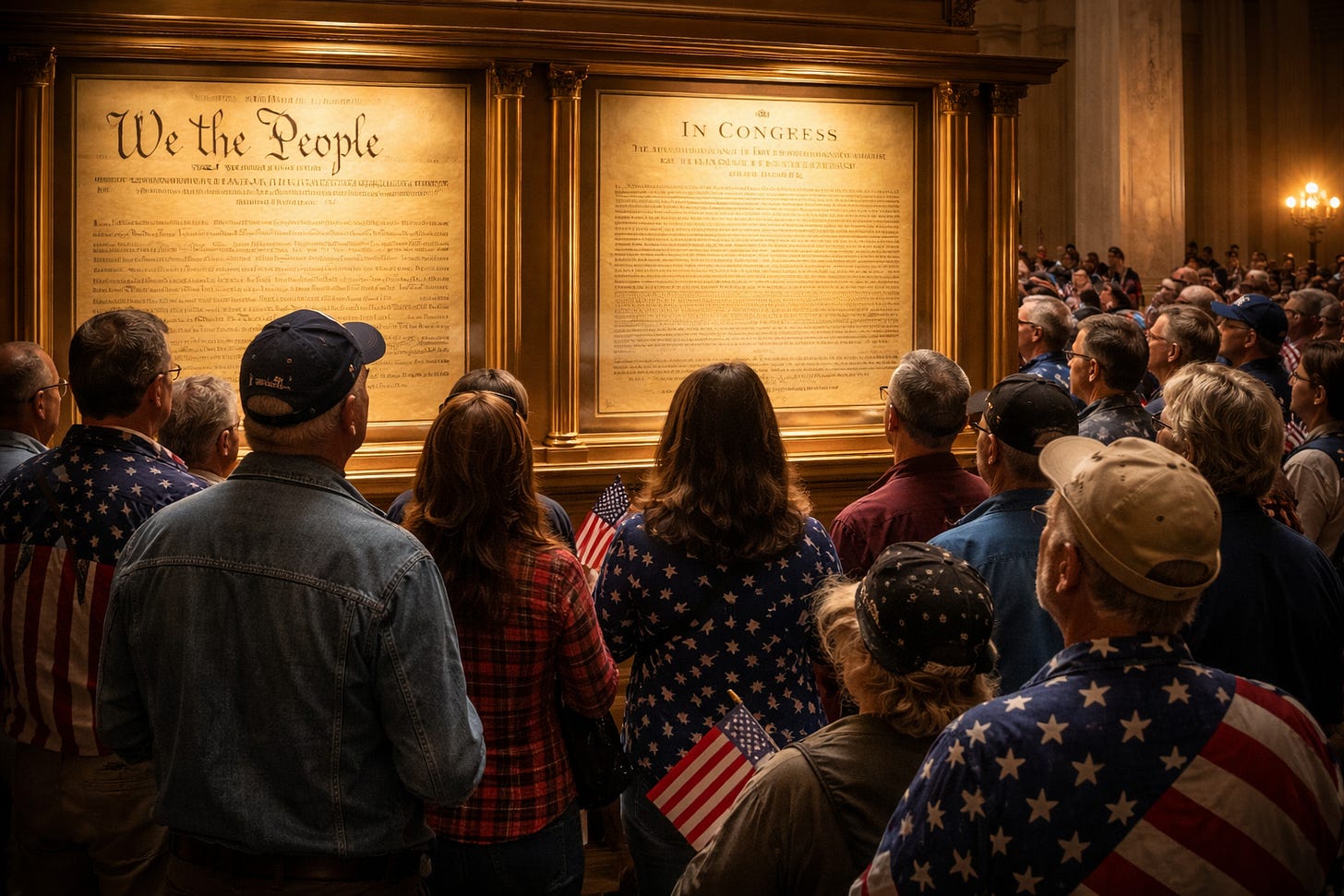
How many articles of clothing do you have in American flag patterns? Belief in the transcendent — A religion need not believe in a personal god, but they do believe in something transcendent. Americanism uses general reference to ‘God’ but never a direct connection to Jesus. The Declaration refers to a ‘Creator,’ and the Preamble to the Constitution has an even broader appeal to a transcendent purpose:
“We the People of the United States, in Order to form a more perfect Union, establish Justice, insure domestic Tranquility, provide for the common defence, promote the general Welfare, and secure the Blessings of Liberty to ourselves and our Posterity, do ordain and establish this Constitution for the United States of America.”
Your participation is important to building a “more prefect Union,” and secure liberty for future generations of Americans.
Symbology — Religions make use of symbols, and Americanism has many sacred objects. We love the bald eagle so much that anyone who kills one of these majestic birds can be sent to prison for up to one year. The symbol is emblazoned on the Great Seal, with an olive branch and arrows grasped in the eagle’s talons.
The American flag is one of our most recognizable symbols, with school children learning the history of the flag and the meaning behind the stars, the stripes, and the colors. It’s considered profane for the flag to touch the ground and when it becomes worn, we burn it in a ceremonial fashion.
Moreover, we have incorporated other flags to symbolize our defiance and independence — The Gadsden Flag (“Don’t Tread on Me), and the “Come and Take It” flag encourage the spirited, maverick theme that loves to challenge anyone who believes themselves superior.
The symbols extend to the likes of the Liberty Bell and the Statue of Liberty. We also build ‘temples’ like the Washington Monument, the Lincoln Memorial, the Capitol, and the Supreme Court building which all look remarkably similar to religious structures in the ancient world.A system of beliefs — Americanism has a broad set of principles which are far more common that one might presume. Citizens often argue about the specifics of politics, but American political ideals include strong convictions on the importance of liberty, equality, democracy, civic duty, popular sovereignty, and the rule of law. These are the basis of our political and legal systems, and for the individuals who do not adhere to our beliefs or moral codes, the price is high. We reward those who comply with our system, and punish those who do not.
Narratives and Myths — We have these themes which we have handed down over the generations to bolster our love of country, while downplaying the negative aspects of who we are.
America is the ‘city on the hill’ — a beacon for the world to view and behold. It reminds us of the special place for the US. During the 19th century, Americans seized on the idea of Manifest Destiny, thinking it was obvious that the United States was always fated to control the North American continent, from ‘sea to shining sea.’
In the 20th century, the idea that Americans are just ‘built different’ continued under a different name — ‘American exceptionalism.’ We want to convince the population that we are a great nation because we are powerful nation with extraordinary people, destined to lead the world.
We tell our people that this is the ‘land of opportunity,’ and describe the ‘American Dream,’ a pathway to a high standard of living if one simply works hard enough.Ritual acts — Most religions incorporate ceremony as a means of reflecting the importance of beliefs. The Americanist attitude reveres these ceremonies. We have school children say a ‘Pledge of Allegiance’ every morning. The national anthem is played at every sporting event, and Americans know the words (at least to the first verse). We celebrate our religious holidays, like Independence Day, with fireworks and feasts. People who do not celebrate or adhere to the rituals are frowned upon.
We witness our leaders sworn into office with ceremony. In fact, the Supreme Court’s pomp and circumstance is so religiously performative, the most orthodox of churches would be envious of their rituals. These leaders wear black robes, don’t permit cameras in the courtroom, have highly secretive debates regarding ‘doctrine,’ and have themselves announced by the bailiff to the sound of “Oyez! Oyez! Oyez!”Religious leaders — The President, regardless of the person or party affiliation, receives an inordinate amount of influence over the nation’s affairs. As both the head of state and the head of government, the president leads many of our ceremonies, and like any good pastor, sets a tone for the congregation about which matters of the faith to prioritize. Our members of Congress and the Supreme Court are akin to a priesthood which has tremendous wealth and privilege.
Proselytizing — Is it really a religion if you don’t try to convert others to your beliefs? One of the unique facets about our political and national structure is that anyone can become an American. It’s a creedal nation, and if you accept the core tenets of the faith, we don’t care about your country of origin.
Do your freedoms in the Constitution matter more to you than the gospel of Jesus? Do you sing the Star Spangled Banner louder than Amazing Grace? Can you recite the Declaration of Independence with greater ease than the Bible? If so, your primary religion might be Americanism.
Donald Trump wants your worship
Patriotism and gratitude for the nation and what it provides are not inherently wrong. The current administration, though, wants Americans unquestioning loyalty and compliance. Trump wants to augment this Americanist religion to one where he becomes the central figure.
President Trump, is counting on citizens to continue their adherence to the cult. He’s more indulgent in the trappings of our civil religion than others before him. Trump wants us to see him as a messiah-like figure, where we will be forever grateful for his leadership. Many Americans are finally realizing that he’s no savior.
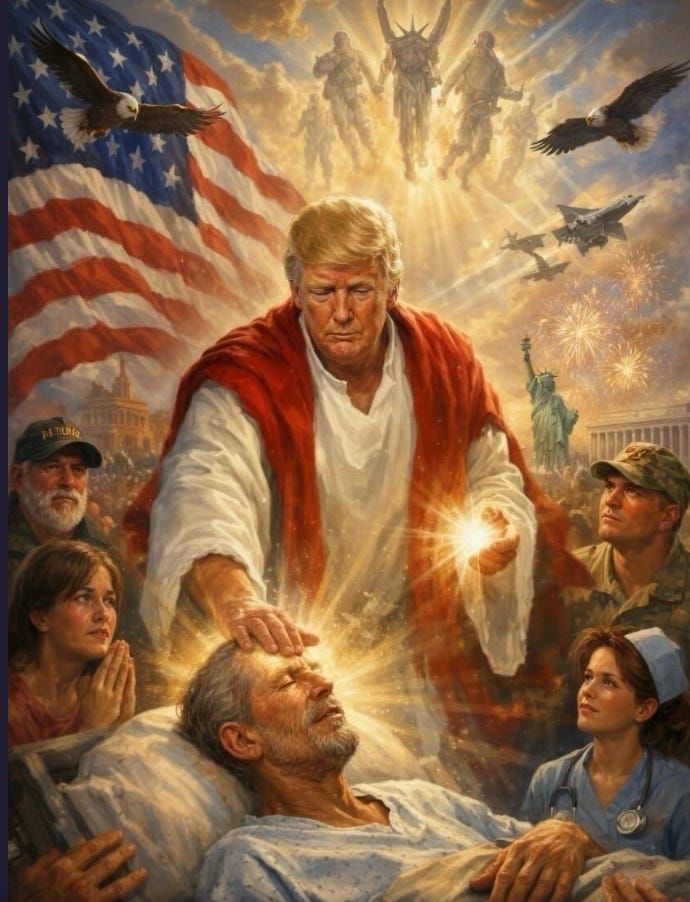
Yesterday, Trump posted an AI-generated picture of himself, looking like Jesus Christ healing a sick man (whom the internet agrees looks remarkably similar to Jeffrey Epstein). But this isn’t his first foray into the blasphemous, messianic rhetoric. Trump constantly uses language and images to elevate himself to a standing beyond the typical American citizen.
During his presidential campaigns, Trump employed language to promote an America that was in dire circumstances, which needed to be returned to its former glory. In conjunction with that language, Trump frequently used speech centering around the notion that “only I can fix it.” Tell me if any of these lines sound familiar: “Nobody knows the system better than me,” “We are being destroyed — only I can stop it,” “Only I can save the country,” “I will be your retribution.”
In 2024, Trump narrowly escaped an assassination attempt, and attributed his survival to divine intervention. Clearly, God had work for Trump to complete here on earth. I suppose that divine favor did not extend to the man who died from the bullet intended for Trump.
Four years earlier, President Trump walked to St. John’s Episcopal Church near the White House and held up a Bible, presumably as a sign of authority in the wake of protests (after George Floyd’s murder). Trump also tried to connect himself to Biblical authority by offering his own “Trump endorsed” version of the Bible, which included not only the Christian holy texts, but also a copy of the Constitution, the chorus to the Lee Greenwood song “God Bless the USA,” and other classic American texts.
No one genuinely believes that President Trump is a god-like figure, but his actions are designed to make people remember him in a far more positive manner than which he deserves. And for his most ardent supporters, it has worked. Despite the fact that the president’s approval rating is hovering in the mid-to-upper 30s, I can’t fathom how one in three Americans approve of this man’s work as president.
Trump continues to push the boundaries of the law and human decency to convince the nation of his greatness. He lies, manipulates, cons people out of money, intimidates, and uses all levers of power to harm those who defy him. Yet, some people still esteem this man.
One of the great ironies of Trump’s attempt to bamboozle the masses is that he is committing the same sin which befell the angel Lucifer. Despite his lofty role in the heavenly order, Lucifer’s pride provoked him to exalt himself rather than the God who made him. God expelled Lucifer from heaven, and tradition holds that he was not the only angel cast out. Lucifer took a third of the heavenly host with him.
Don’t drink the kool-aid.
Good one